










You may have seen it before: a chalky white coating around your faucet, cloudy spots on your shower door, 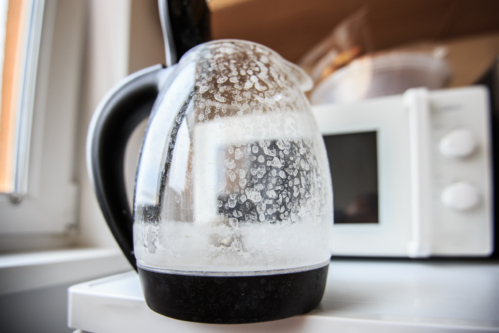 or crusty buildup around a showerhead. It can be easy to dismiss these deposits as another household problem, but what you’re seeing is limescale, one of the most noticeable signs of hard water.
While the buildup on your fixtures may be frustrating, the limescale you can see is only part of the problem. The same minerals can accumulate inside your pipes, water heater, dishwasher, washing machine, and other water-using appliances. Over time, that buildup can restrict water flow, interfere with heating efficiency, and contribute to premature wear on household equipment.
Understanding what limescale is, why it forms, and what you can do about it can help you protect your home before a small layer of mineral buildup becomes a problem.
What Exactly Is Limescale?
Limescale is a hard, chalky mineral deposit primarily made up of calcium carbonate. It forms when hard water leaves behind dissolved minerals on surfaces.
Hard water contains naturally occurring minerals, particularly calcium and magnesium. As groundwater travels through limestone and other mineral-rich rock, it picks up these minerals before eventually entering municipal water supplies or private wells.
The minerals themselves aren’t necessarily a problem while they’re dissolved in the water. The trouble begins when conditions cause them to come out of solution and form solid deposits.
That’s when limescale begins to appear.
Depending on your water chemistry and the surface involved, limescale may look off-white, gray, or slightly yellow, powdery, chalky or crusty, or cloudy. The more mineral-rich your water is, the greater the potential for scale formation.
Why Does Limescale Form?
Two everyday processes make limescale particularly noticeable: heating and evaporation. 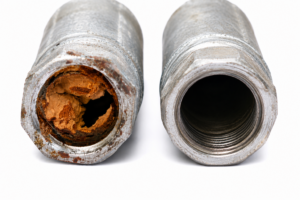
Think about what happens when droplets of hard water dry on a glass shower door. The water evaporates, but the minerals dissolved in it don’t evaporate with it. They’re left behind on the surface.
Repeat that process hundreds of times, and visible mineral deposits begin to form.
Heating hard water can accelerate scale formation as well. That’s why limescale is commonly associated with equipment such as water heaters, coffee makers, kettles, dishwashers, washing machines, and hot-water plumbing.
Every time hard water passes through these systems, there’s an opportunity for additional mineral deposits to accumulate.
A little buildup may not seem significant. But limescale is a cumulative problem. Layer after layer can form over months and years, gradually creating a thicker and harder deposit.
Where Does Limescale Build Up in Your Home?
Some signs of limescale are easy to spot. Others remain hidden until they begin affecting equipment performance.
Faucets & Showerheads
Minerals commonly collect around faucet aerators and showerhead openings. Eventually, deposits may interfere with water flow, causing individual shower jets to spray unevenly or reducing flow through a fixture.
Sinks, Tubs, & Shower Doors
When hard water evaporates, it can leave behind cloudy spots and chalky residue. Soap can also react with hardness minerals, contributing to stubborn buildup around sinks, tubs, tile, and glass.
Water Heaters
Your water heater can be particularly vulnerable because heating encourages scale formation. Mineral deposits may accumulate on heating elements or internal surfaces, potentially interfering with efficient heat transfer.
Dishwashers
Hard water can leave spots or cloudy residue on dishes and glassware while also allowing deposits to form on internal dishwasher components.
Washing Machines
Mineral buildup can affect components that regularly come into contact with water. Hard water may also interfere with the performance of soaps and detergents, potentially causing homeowners to use more product.
Pipes
Perhaps most importantly, limescale can develop inside plumbing where you can’t see it. As deposits build along the interior walls of a pipe, they can gradually reduce the space available for water to flow.
Why Should You Care About Limescale?
It Can Reduce Water Flow
As scale accumulates inside fixtures and plumbing, opening can become increasingly restricted. You might first notice reduced pressure from a showerhead or faucet, but significant buildup inside plumbing can create a larger issue.
It Can Affect Water-Heating Efficiency
Limescale can create an insulating barrier between a heating surface and the water it’s trying to heat.
When heat transfer becomes less efficient, water-heating equipment may need to work harder or longer to achieve the designed temperature. That can mean unnecessary energy use as well as additional stress on equipment.
It Can Shorten the Life of Appliances
Dishwashers, washing machines, water heaters, and other water-using equipment contain valves, heating elements, pumps, and other components that mineral deposits affect. Over time, scale accumulation may contribute to reduced performance, additional maintenance, or premature component failure.
It Creates More Cleaning
Limescale is stubborn. Once deposits harden, ordinary wiping may not be enough to remove them. Homeowners may find themselves repeatedly cleaning faucets, showerheads, glass shower doors, sinks, and tiles. But no matter how much they scrub, the white spots never seem to truly go away.
Addressing scale formation, especially early, can mean less time spent fighting the same white residue week after week.
How Do You Know If You Have a Limescale Problem?
Visible mineral deposits are often the easiest clue, but there’re several other signs to watch for.
Your home may have a hard water problem or a limescale problem if you regularly notice: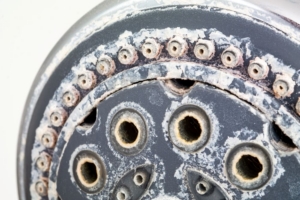
- White or chalky buildup around faucets
- Cloudy spots on glassware
- Scale around showerheads
- Soap scum that’s difficult to remove
- Reduced water flow from fixtures
- Frequent scaling inside coffee makers or kettles
- Water-using appliances requiring repeated descaling
If you’re unsure about your home’s water hardness, you can also use an at-home water hardness test or review a water quality report from your local water supplier.
Knowing your water hardness can help you understand how likely your home is to experience significant scale formation.
Removing Limescale Vs. Preventing It
When limescale appears on a faucet or showerhead, acidic household cleaners or commercial descaling products can often help dissolve the deposits.
But cleaning existing scale doesn’t address the reason it formed.
If hard water continues flowing through your home, new mineral deposits can begin forming again almost immediately. That creates an ongoing cycle:
Scale forms → You clean it → Scale returns → You clean it again
For long-term protection, it makes sense to think beyond removing existing buildup and consider how to reduce future scale formation.
What Are Your Options for Managing Limescale?
There are several ways homeowners can approach hard water and scale.
Traditional water softeners use ion exchange to remove hardness minerals such as calcium and magnesium from the water. They can be effective, but they typically require salt, regeneration cycles, ongoing maintenance, and additional water use.
Chemical descaling products can remove existing deposits from individual fixtures or appliances but need to be reapplied whenever scale returns.
Electronic water descalers take a different approach. Instead of removing beneficial minerals from the water, electronic descaling technology is designed to alter how those minerals behave, reducing their tendency to attach to surfaces and develop into hard scale.
The right approach depends on your water conditions, household needs, maintenance preferences, and goals.
Take a Proactive Approach with ScaleSweeper
ScaleSweeper provides an alternative for homeowners who want to address limescale without adding salt or chemicals to their water.
The electronic water descaler uses electromagnetic technology designed to change the physical behavior of hardness minerals as water travels through the plumbing system. Rather than removing calcium and magnesium, ScaleSweeper helps reduce their ability to attach to plumbing and water-using equipment as hard limescale.
That means homeowners can help protect areas throughout the home, including pipes, water heaters, faucets, showerheads, and dishwashers.
Because ScaleSweeper doesn’t use salt or chemicals and doesn’t require a regeneration cycle, it provides a low-maintenance approach to scale control.
Don’t Ignore the Scale You Can See
A little white residue around a faucet might not seem like a reason for concern. But it can tell you something important about what’s happening every time hard water moves through your home.
The minerals creating visible deposits on your fixtures can also be interacting with pipes, heating elements, and appliances where you can’t easily see them. Over time, those deposits can affect water flow, equipment efficiency, cleaning requirements, and appliance performance.
Removing existing deposits can keep surfaces looking clean, but preventing limescale from forming in the first place provides a more proactive approach.
By understanding your home’s water and taking steps to manage scale, you can help protect your plumbing, appliances, and fixtures while spending less time scrubbing away the evidence of hard water.
With ScaleSweeper, controlling limescale doesn’t have to mean removing minerals from your water or constantly adding salt and chemicals. It means addressing the problem before those minerals have the opportunity to become stubborn scale.
