











Hard water affects millions of homes, quietly causing scale buildup inside pipes, water heaters, dishwashers, and washing machines. Over time, this mineral buildup reduces efficiency, increases energy bills, and shortens appliance lifespan.
While looking into cost-effective ways to cut down on the scale in your pipes, you may have come across the concept of electronic water descalers. They sound fancy, but how do they work exactly? And how are they different from traditional salt-based softeners?
Let’s take a minute to break down the science behind electronic water descaling, how the technology prevents limescale, and why it’s become a modern solution for protecting your home from hard water damage.
First, What Is Hard Water?
Hard water contains elevated levels of dissolved minerals, primarily calcium and magnesium. These minerals are naturally picked up as water travels through rock and soil. While they are safe to drink, problems occur when hard water is heated or allowed to evaporate.
When that happens, calcium and magnesium crystallize and form limescale, a hard, chalky deposit that sticks to pipes, heating elements, faucets and fixtures, showerheads, and appliances. Over time, scale buildup restricts water flow, reduces heating efficiency, and damages internal components.
Why Scale Forms in the First Place
To understand the benefit of electronic descaling, it helps to understand why scale forms.
When hard water is heated, like inside a water heater, calcium bicarbonate converts into calcium carbonate, which is a solid mineral. That’s what sticks to surfaces and forms scale.
The hotter the water, the faster this reaction occurs. That’s why water heaters, tankless systems, boilers, and dishwashers are often the first appliances to suffer damage.
Electronic descaling works by influencing this crystallization process before the minerals attach to surfaces.
Traditional Solutions vs. Electronic Descaling
To understand how electronic descalers work, it helps to compare them to traditional water softeners.
Salt-Based Water Softeners
These systems use tanks and salt tablets or salt crystals to remove calcium and magnesium through ion exchange, replacing them with sodium. This chemically changes the water, making it soft.
Though they effectively eliminate formation and reduce soap scum and spotting, they require manual maintenance with regular salt refills and increase the amount of sodium that’s in the water. They also require plumbing modifications and higher installation costs.
Electronic Water Descalers
Electronic descalers do not remove minerals from the water. Instead, they change how the minerals behave, preventing them from forming hard, adhesive scale. By modifying calcium and magnesium minerals using electromagnetic frequencies transmitted through coils wrapped around the water pipe, the minerals stay suspended in the water as tiny crystals that don’t attach to surfaces.
This distinction is critical: electronic descaling focuses on scale prevention, not mineral removal.
The Core Technology: Electromagnetic Frequency Modulation
Electronic water descalers use electromagnetic frequencies to influence mineral crystallization.
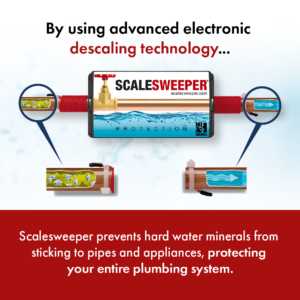
Electronic Descaler
Here’s how it works step-by-step:
- The Device Wraps Around the Main Water Line – An electronic descaler is installed by wrapping signal coils around the incoming water pipe. There is no cutting, plumbing modification, or pipe intrusion.
- The Unit Emits Electromagnetic Waves – The system generates controlled electromagnetic frequency signals that pass through the pipe wall and into the flowing water.
- Mineral Crystals Are Altered – As water flows through the treated pipe section, the electromagnetic field affects the structure of dissolved calcium and magnesium ions. Instead of forming flat, adhesive crystals, which stick to surfaces, the minerals form microscopic, rounded crystals that remain suspended in the water.
- Scale Can No Longer Stick – Because the altered crystals do not easily bond to pipe walls or heating elements, scale formation is dramatically reduced. The minerals stay in the water and are carried harmlessly through the system.
What Happens to Existing Scale?
One of the most common questions homeowners ask is: Can an electronic water descaler remove existing buildup?
The answer is: yes, but gradually.
When new scale formation is prevented, the water flowing through the system slowly interacts with existing deposits. Over time, existing scale begins to loosen, deposits break down layer by layer, and pipes and heating elements regain efficiency.
This process isn’t instant. Depending on hardness levels and buildup severity, improvements may take weeks or months, but they are continuous.
As soon as they’re installed, electronic descalers like ScaleSweeper begin loosening existing scale in both the hot and cold water systems. By day 16, homeowners will notice that it’s easier to wipe ceramic, plastic, glass, and metal surfaces clean and a reduction of scale from faucets, showerheads, and pipes.
After the first month or two, homeowners will notice a significant reduction of scaly crust or stains in toilets or under faucets with no signs of new stains forming. Water should heat quicker by now using less energy to achieve the right temperature.
The full effects may take up to 12 weeks, especially if the system has been heavily scaled up over many years, but gradually appliances will be scale-free and running much more efficiently, resulting in less maintenance and saving money.
What Electronic Water Descalers Do NOT Do
It’s important to understand that electronic descalers are not the end-all be-all solution. To set proper expectations, they can’t remove calcium or magnesium from the water, can’t make water feel “silky” like softened water, and can’t reduce water harness readings on test strips.
Instead, they prevent mineral adhesion and further scale buildup. This is why electronic descalers are often preferred by homeowners who want:
- Appliance protection
- Lower energy costs
- Low maintenance
- No salt or chemicals
- Environmentally friendly operation
All of that without altering drinking water chemistry.
Benefits of an Electronic Water Descaler
When working properly, electronic descalers deliver several long-term benefits.
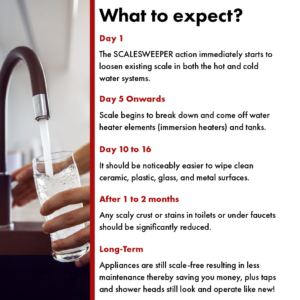
What to Expect with Descaler
- Improved Appliance Efficiency – Scale acts as insulation. Just 1/16 inch of scale on a heating element can reduce efficiency by up to 12%. By preventing scale, water heaters heat faster and use less energy.
- Extended Appliance Lifespan – Less buildup means fewer heating element failures, reduced pump stress, and longer life for dishwashers and washing machines. This saves money in the long run, letting you get more use out of expensive appliances without frequent maintenance or replacement.
- Maintained Water Pressure – Scale buildup narrows pipe diameter. Preventing this ultimately preserves normal flow and pressure.
- Eco-Friendly Operation – Electronic descalers use no salt, waste no water, and produce no chemical discharge. They’re ideal for environmentally conscious homeowners.
- Zero Maintenance – Once installed, systems like ScaleSweeper operate continuously without salt refills, filter replacements, regeneration cycles, and plumbing adjustments.
How ScaleSweeper Enhances This Technology
Not all electronic water descalers operate at the same level of precision. Frequency strength, modulation pattern, and engineering quality matter.
ScaleSweeper stands out as the #1 laboratory-tested hard water descaler, using optimized electromagnetic frequency patterns to ensure consistent mineral alteration across varying hardness levels.
Key advantages include:
- Scientifically tested signal calibration
- Precision frequency modulation
- Whole-house protection
- Effective performance in high-hardness regions
- Continuous 24/7 operation
- No maintenance required
- No infrastructure modifications required
Rather than relying on static magnetism, ScaleSweeper uses dynamic frequency patterns engineered to maximize crystal transformation.
Is an Electronic Water Descaler Right for You?
Now that you’ve learned more about electronic water descalers, you should have a clearer idea of if one is the right choice for your home. To summarize, they work by using electromagnetic frequencies to alter how calcium and magnesium minerals crystallize. Instead of sticking to pipes and appliances as hard limescale, treater minerals remain suspended in the water.
They’re ideal for homeowners who may experience moderate to high water hardness and want to protect appliances from scale damage without needing to add sodium to the water. They’re a low-maintenance solution with minimum to zero environmental impact.
Electronic descalers are particularly effective for homes looking for preventive protection rather than water chemistry modification.

